
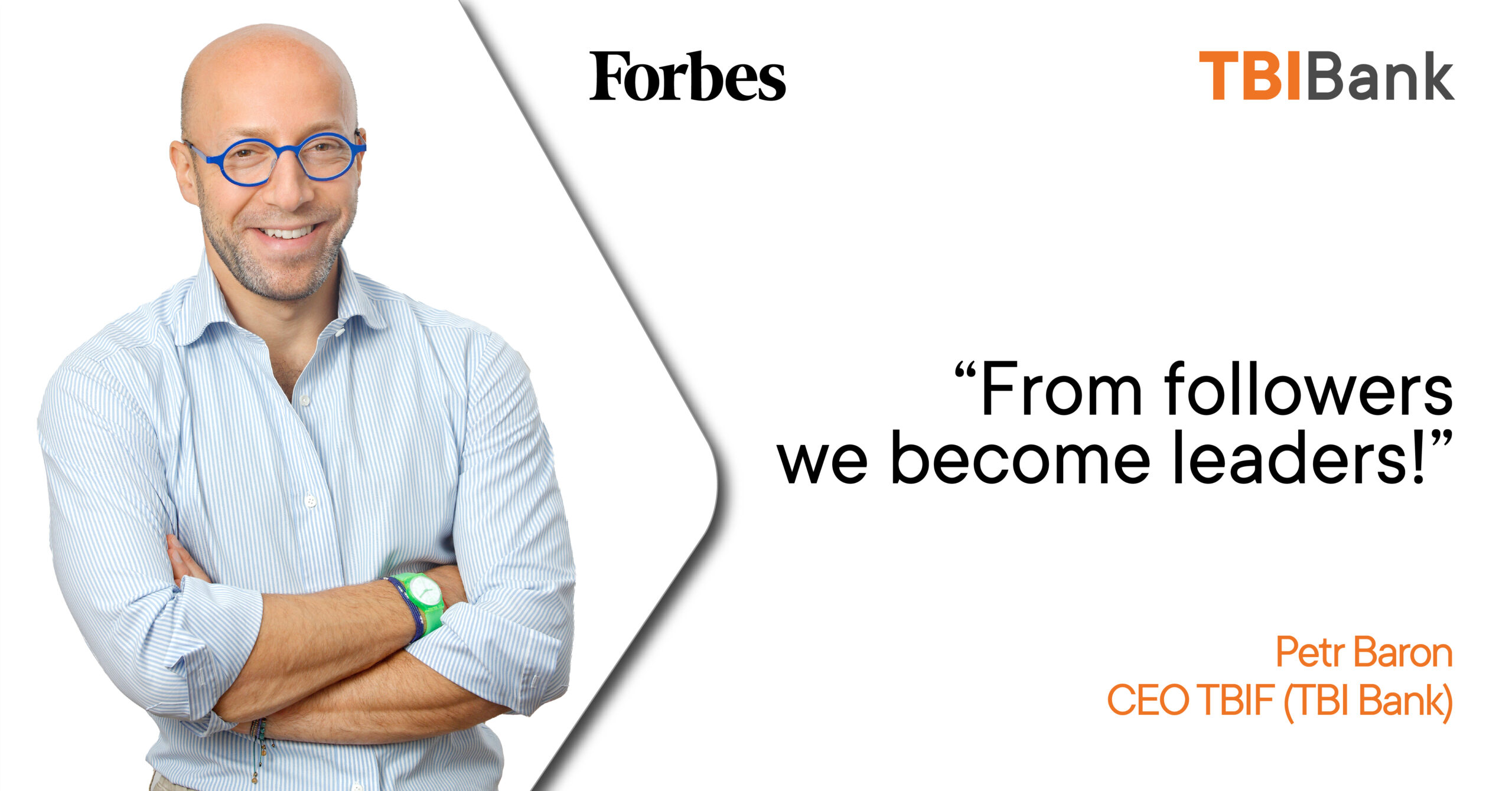
Petr Baron for Forbes Romania: From followers, we become leaders!
In just 4 years TBI Bank transformed to a digital lender with clear focus on services making a difference for the customers. We spoke to Petr Baron, the driving force of the transformation, on the achievements and challenges on the way.
Mr. Baron, we last spoke 3 years ago – what changed since for TBI?
Back then we were at the beginning of a very ambitious journey to transform our business and the mindset of the team. I can put it even shorter – from followers to becoming leaders. The Romanian market is very competitive and quite developed. We understood that we are coming a little bit late to the party, so we needed to pick our battles. There were opportunities in areas, where we can really excel and prove both to ourselves and most important to customers that we can do something better than others. Over time our team improved many processes and products and we continue to develop everything in an agile manner, because what we believe in as organization, is the continuous improvement. This mindset not only led to our success in merchant solutions, consumer cash credits, business loans or deposit solutions – we now serve our customers much, much better. Let me give you an example: Many small businesses require short term working capital and are clearly underserved because anywhere they go, the process takes weeks, if not months. We at TBI Bank offer cash loans online where the time to money can be anywhere between 24 and 48 hours. This is groundbreaking even for strongly developed digital markets such as USA or UK. Such speed and convenience distinguish many of our other products – point-of-purchase loans or deposits. If you put atop the fact that internally the team works as a fintech startup, dares to experiment, to make mistakes and learn from them – we’ve made a huge step forward in the past three years and I see how our customers see and appreciate our transformation. From followers we at TBI are now leaders. Last year we’ve received over million loan applications – that huge figure shows we’re moving in the right direction.
You’ve recently introduced a new brand architecture – would you walk us through it please and describe the transformation it brings?
When the bank was acquired back in 2016, we thought for a long time whether we should change the name since it was not that recognized by Romanians. However, we’ve decided to use this in our advantage and put TBI at the center of a universe of products and services. So to say, to make a bold move from a pure corporate brand to a brand that is associated with many products, coherently living together. Nothing changes, we only provide even more simplicity and convenience to our customers and partners. Now that Romanians know they can rely on TBI’s quality services, they will also know what exactly to expect from each one of our channels. You go to TBI Bank to deposit your money or as a corporate client. TBI Money and its flagship product TBIDuo back up our inclusive lender concept and offer cash loans to the underserved. TBIPay helps our merchant partners sell more and our mass customers – purchase the desired product now and pay later in installments. You probably see that our point was to name the ship the way we want it to sail. It did take us a while to align on this concept. But now that we’re there we’ve noticed that it’s a big trend and a lot of other companies are doing it and are following us. What they don’t know yet – for us this is just the beginning! Over the time we will embed more convenient products and solutions under the brand TBI.
You stand out with your competitive interest rates on deposits – what is the rationale behind them?
We’re very happy to offer to our customers interest rates that are above the inflation rate in Romania. With us you not only hold your savings in the safest possible way – you also earn real money. The reasons for that are simple. Firstly, the majority of our deposit base in Romania is acquired fully digital. This is not only convenient for the customers, that way we don’t need to carry the big infrastructure cost the majority of other banks have in order to facilitate this business. Secondly, our overall business model is focused on inclusive lending. Our loan tickets are not big, we don’t offer mortgages, the merchants offering our point-of-purchase solutions compensate part of the cost for the customers. In short, we are very efficient, in fact traditionally among the most efficient and profitable banks in Southeast Europe. That gives us the opportunity to offer our competitive interest rates thus sharing our business successes with our depositors. Besides the great rate, I’d like to mention something else that is of very high importance for the depositors – the quality of the support we provide when onboarding our online depositors. Traditionally, people are not that comfortable depositing their money without interacting with a real person and therefore we decided to have designated customer support for our clients. This approach not only boosted our business further but elevated our customer’s satisfaction to world-class levels. I am proud to say that we maintain a net promoter score of 80+ – an industry benchmark, reachable by very few banks on global level.
While on this topic – how did COVID-19 affect the savings of Romanians?
Romanians don’t make a difference from the global trend – they are spending less and saving more. Some are looking to invest – property, gold, stocks, but at the end of the day the majority of people prefer to save money in banks because of the high level of security coming from the Deposit Protection schemes. So, we are seeing a very strong trend of deposit growth since the start of the pandemic in both our online and offline distribution channels. I think that from now, at least for the next 6-7 months, as the lockdown continues and there’s no full clarity about how we will come out of this situation, it’s only natural for people to prepare for a rainy day and trend will continue.
Can you tell us more about the other services you offer?
We don’t want to be a universal bank, we are a fintech bank. And we are constantly transforming, therefore for TBI it is very important to focus on understanding customers’ needs and stand out in an already competitive market. Which is why in Romania we actually have only five core phygital products that we offer. I already mentioned the deposits that we mainly collect safely and securely online. Then we have our business banking division which has traditionally been very strong. There we’ve identified the niche of small and medium enterprises that require funds fast online – and TBI Bank is there to support them. In terms of retail customers, where we also have strong position and a lot of loyal customers, we offer two products running under the TBI Money brand. One is a classic any purpose loan. The other was launched recently and we’re quite proud of it. It’s called TBIDuo and really backs up our inclusivity strategy. What does this mean? TBI is in the business of helping customers power their needs. TBIDuo is the perfect example for that strategy. In essence, it is also an any purpose loan aimed at people who do not qualify for receiving funds out of one or another reason. They can bring in a guarantor – usually a spouse or a parent if it is a younger person – who guarantees the loan. If they trust you, we do, too. That way TBIDuo can help many Romanians to enter their own credit life, build up a credit history and receive funds in the future. And, finally, also aimed at retail customers, comes the most important product that we have in Romania: Our checkout financing service TBIPay.
Why is it so important? What is the innovation behind this point-of-purchase offer?
As a type of product TBIPay is becoming more and more popular over the world: It’s what fintechs call “buy now, pay later”. What distinguishes us from them is that TBI has been active in the point-of-purchase segment for many years now. We know in-depth both the needs of our merchant partners and our customers. The beauty of TBIPay is that it’s a service. Someone wants to easily buy or finance anything in installments – from a fridge to a visit at the dentist. This customer is not looking for a new bank, he’s looking for convenience, for a tool to help him get what he needs now, and not in three years. TBIPay shows what we stand for as a company – customer focused platform with high added value and a huge potential for embedded services in the future. Where we are now is the stage where we help merchants sell more – both online, and in store. Additionally, we have the hybrid model, which we call ‘anti-queue’ for people who start their financing journey in store and finish it online. We are now adding an extra service where we let them finance even smaller purchases and think that TBIPay is a win-win-win service. However, the stage we’re in now is really just the beginning.
If I go deeper into our strategy, mid-term we want to provide more embedded services both to our merchant partners and our customers. And for every Romanian it means that once on board of TBIPay he’ll get more exclusive offers from us and our partners. All this makes us a much more a fintech than a bank.
What products do you plan to launch in 2021?
Very soon we’ll launch TBI Quatro – with it we’ll be financing purchases of up to 300 Euro. Its best feature is that if the installments are paid in time it will be interest free. Parallel to this, we are working on our own checkout functionality, so that we can provide a fully integrated experience to our partners. They will be able to accept card payments, the point-of-purchase financing will be even quicker and seamless. Over the year we will be working on integrating аn IBAN into our ecosystem in order to provide customers with a holistic experience. The current account will be connected to a cool debit card and an application and it will have a preapprove credit limit based on the history in the relationship with TBI. Also, we’ll further develop our cash online proposition.
What is the effect of COVID-19 on your business – and what is your reaction?
We started getting prepared before many other companies and that makes me very proud of the team. For us as a bank, it was important our services not to be uninterrupted and we keep on lending and supporting our customers in these challenging times. Early February we also started making sure that we were able to protect both our customers and employees. But one question came up: how to do so when you don’t know what the disease is, how it’s spreading and how it’s going to affect the world that we live in… Our very lean structure and open-minded entrepreneurial attitude in the organization helped a lot in this situation. The team was even more vocal than usual and came up with solutions to problems before they actually appeared.
We also implemented a four-pillar strategic approach based on cost optimization, liquidity management, and ensuring our customers’ and teams’ safety. At the same time, we were looking for opportunities, because crises always bring such. Continuing to adapt to the new way of living and working together with speeding up all the processes that are ongoing, will remain our goal for 2021. Of course, combined with all measures to keep everyone safe.
At the same time, I keep on telling the team that the pandemic gives us a unique chance to outperform. Because of the changing customer needs everything we’ve planned over 10 years’ time, now got squeezed into the next three to five years maximum. If we adapt and evolve quicker than the others, we’ll not only stay competitive but create a long-lasting positive impact on TBI’s business.
Finally, will 2021 bring us forward in terms of fintech development – or will the world be too busy with the “new normal”?
To me these two things are connected – the digitalization of financial services driven by consumer needs’ and the effects of the pandemic. Every major turmoil in history has led to a situation where someone wins, and someone loses. In the last months the business models of some fintechs have been exposed and they might not survive. Others will evolve and find a way, and of course many of the fintech companies we all know will be bought by established big banks, who will use them as platforms. Same story as in your previous question: these processes would have happened anyway, but the digital rush caused by the pandemic will only make them faster. And at the end of the day the customers will benefit from all this. Everyone who started using digital services recently – and here I don’t mean only when it comes to finance – realized they don’t need the old way of doing business. We are now more demanding since the digital services are much more transparent and convenient. Suddenly everyone is getting used to them – and then there is no way back.

#In the press
tbi bank donates 62,500 lei to the main Craiova hospital for medical needs due to the COVID-19 pandemic
4 mai 2022


#In the press
TBI Bank expands its savings offer by introducing a 15-months deposit with top interest of 4.4%
14 ianuarie 2020

#In the press
WHEN THE CUSTOMER TRULY BECOMES KING: Petr Baron, CEO of TBIF (TBI Bank), talks to Business Magazine
23 aprilie 2019

#In the press
TBI Bank and PayU launch a new payment method for convenient online shopping
15 aprilie 2019